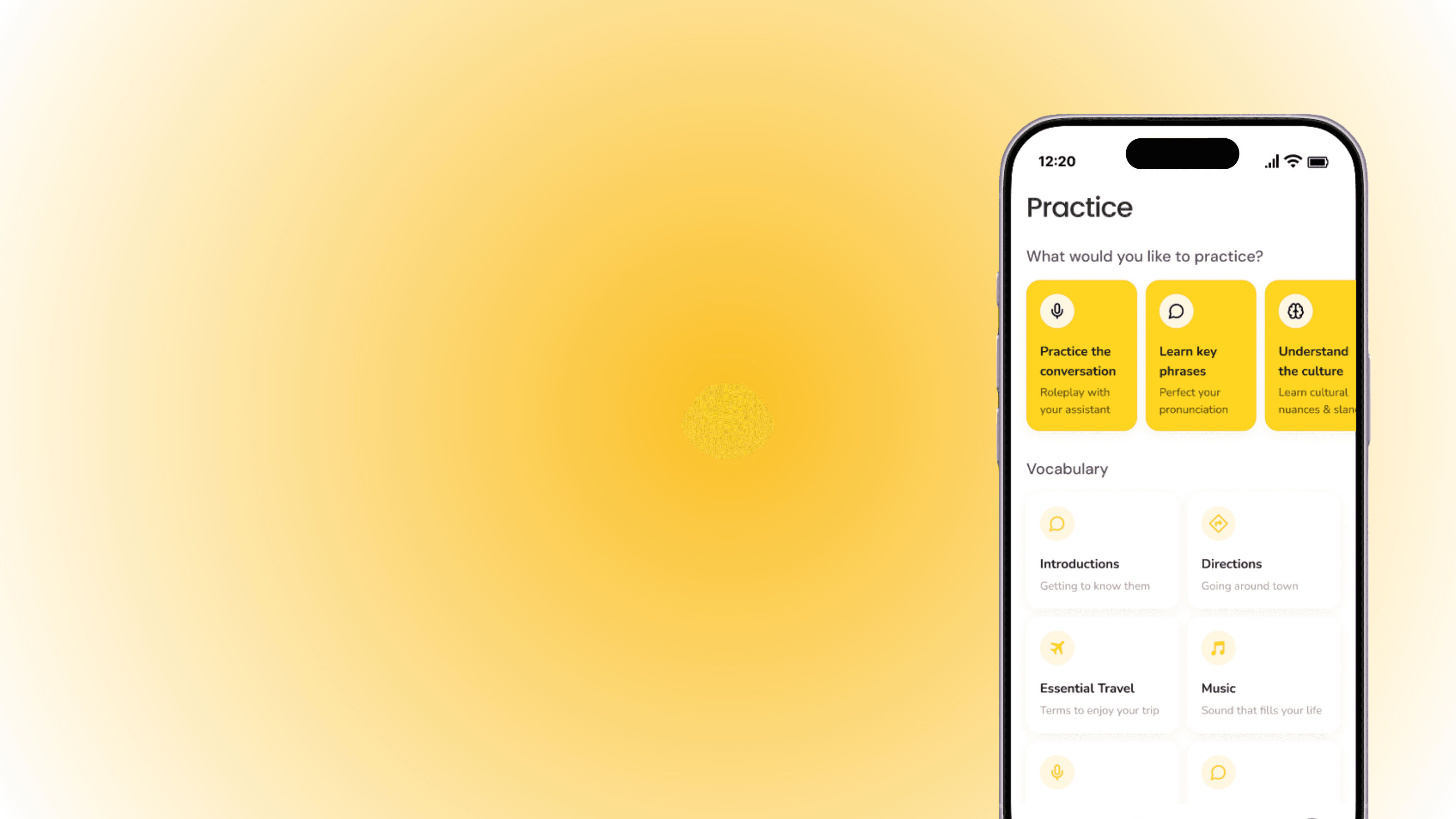
Where language learning meets real human connection.
Where language learning meets real human connection.
Bumble Language Fluency mode enables expats and international students to foster language learning-connections.
Bumble Language Fluency mode enables expats and international students to foster language learning-connections.
mobile app
mobile app
extension
extension
project
project
Where language learning meets real human connection.
Bumble Language Fluency mode enables expats and international students to foster language learning-connections.
mobile app
extension
project
Where language learning meets real human connection.
Bumble Language Fluency mode enables expats and international students to foster language learning-connections.
mobile app
extension
project
Bridging the gap between knowing a language and actually living in it.
Bridging the gap between knowing a language and actually living in it.
Bumble Fluency is a feature extension of Bumble that helps expats and international students build conversational confidence in their target language by connecting them with nearby language partners for asynchronous conversations, AI-powered phrase breakdowns, and matching with potential for in-person meetups. The design bridges the gap that language learning apps like Duolingo leave between structured lessons and real-world fluency.
Bumble Fluency is a feature extension of Bumble that helps expats and international students build conversational confidence in their target language by connecting them with nearby language partners for asynchronous conversations, AI-powered phrase breakdowns, and matching with potential for in-person meetups. The design bridges the gap that language learning apps like Duolingo leave between structured lessons and real-world fluency.
Bumble Fluency is a feature extension of Bumble that helps expats and international students build conversational confidence in their target language by connecting them with nearby language partners for asynchronous conversations, AI-powered phrase breakdowns, and matching with potential for in-person meetups. The design bridges the gap that language learning apps like Duolingo leave between structured lessons and real-world fluency.
my role
my role
my role
User Experience Designer & Researcher
User Experience Designer & Researcher
User Experience Designer & Researcher
timeline
timeline
timeline
3 Months
3 Months
3 Months
tools and methods
tools and methods
tools and methods
Figma, FigJam, Pen and Paper, User Research, User Testing, Competitive Analysis, Prototyping.
Figma, FigJam, Pen and Paper, User Research, User Testing, Competitive Analysis, Prototyping.
Figma, FigJam, Pen and Paper, User Research, User Testing, Competitive Analysis, Prototyping.
key deliverables
key deliverables
key deliverables
Mobile app design prototype.
Mobile app design prototype.
Mobile app design prototype.

01. identifying the problem space
01. identifying the problem space
01. identifying the problem space
initial research
We conducted 7 interviews with expats, international students, and language learners across a range of ages, backgrounds, and proficiency levels. Interviews covered three core areas, including language learning tools and methods, social experiences, and cultural connection.
problem statement
To drive our research, ideation, and ultimate designs, we drafted the following problem statement:
Ex-pats and international students experience isolation and lack of connection abroad, with language barriers as a key contributor. However, language learning apps optimize for engagement over real conversation, leaving users fluent in lessons but less prepared socially. Our design aims to fill the gap between knowing a language and actually living in it.
Our Solution
We extended Bumble's existing architecture with a Fluency Mode. This is a new onboarding path and swiping mode that matches users by language goals, proficiency level, and location for learning and conversations. An AI layer identifies key slang and casual phrases from each exchange, giving users contextual vocabulary in the moment they encounter it naturally.
initial research
We conducted 7 interviews with expats, international students, and language learners across a range of ages, backgrounds, and proficiency levels. Interviews covered three core areas, including language learning tools and methods, social experiences, and cultural connection.
problem statement
To drive our research, ideation, and ultimate designs, we drafted the following problem statement:
Ex-pats and international students experience isolation and lack of connection abroad, with language barriers as a key contributor. However, language learning apps optimize for engagement over real conversation, leaving users fluent in lessons but less prepared socially. Our design aims to fill the gap between knowing a language and actually living in it.
Our Solution
We extended Bumble's existing architecture with a Fluency Mode. This is a new onboarding path and swiping mode that matches users by language goals, proficiency level, and location for learning and conversations. An AI layer identifies key slang and casual phrases from each exchange, giving users contextual vocabulary in the moment they encounter it naturally.
initial research
We conducted 7 semi-structured interviews with expats, international students, and dedicated language learners across a range of backgrounds and proficiency levels. Interviews covered three core areas: language learning tools and methods, social integration experiences, and cultural connection.
problem space
Across all interviews, the most consistent finding was a stark gap between structured learning and real-world conversation — one participant estimated only 5% of her functional English came from formal study, while the rest came from simply living in the US. Fear of judgment, unfamiliarity with slang and colloquial expressions, and the absence of low-pressure spaces to practice were the dominant pain points. Existing tools like Duolingo optimize for engagement metrics over actual conversational readiness, leaving intermediate and advanced learners without meaningful support.
Our Solution
We extended Bumble's existing social infrastructure with a Fluency Mode — a new onboarding path that matches users by language goals, proficiency level, and location for asynchronous voice memo conversations. An AI layer surfaces key slang and casual phrases from each exchange, giving users contextual vocabulary in the moment they encounter it naturally.
initial research
We conducted 7 semi-structured interviews with expats, international students, and dedicated language learners across a range of backgrounds and proficiency levels. Interviews covered three core areas: language learning tools and methods, social integration experiences, and cultural connection.
problem space
Across all interviews, the most consistent finding was a stark gap between structured learning and real-world conversation — one participant estimated only 5% of her functional English came from formal study, while the rest came from simply living in the US. Fear of judgment, unfamiliarity with slang and colloquial expressions, and the absence of low-pressure spaces to practice were the dominant pain points. Existing tools like Duolingo optimize for engagement metrics over actual conversational readiness, leaving intermediate and advanced learners without meaningful support.
Our Solution
We extended Bumble's existing social infrastructure with a Fluency Mode — a new onboarding path that matches users by language goals, proficiency level, and location for asynchronous voice memo conversations. An AI layer surfaces key slang and casual phrases from each exchange, giving users contextual vocabulary in the moment they encounter it naturally.
02. user research
02. user research
02. user research
competitive analysis
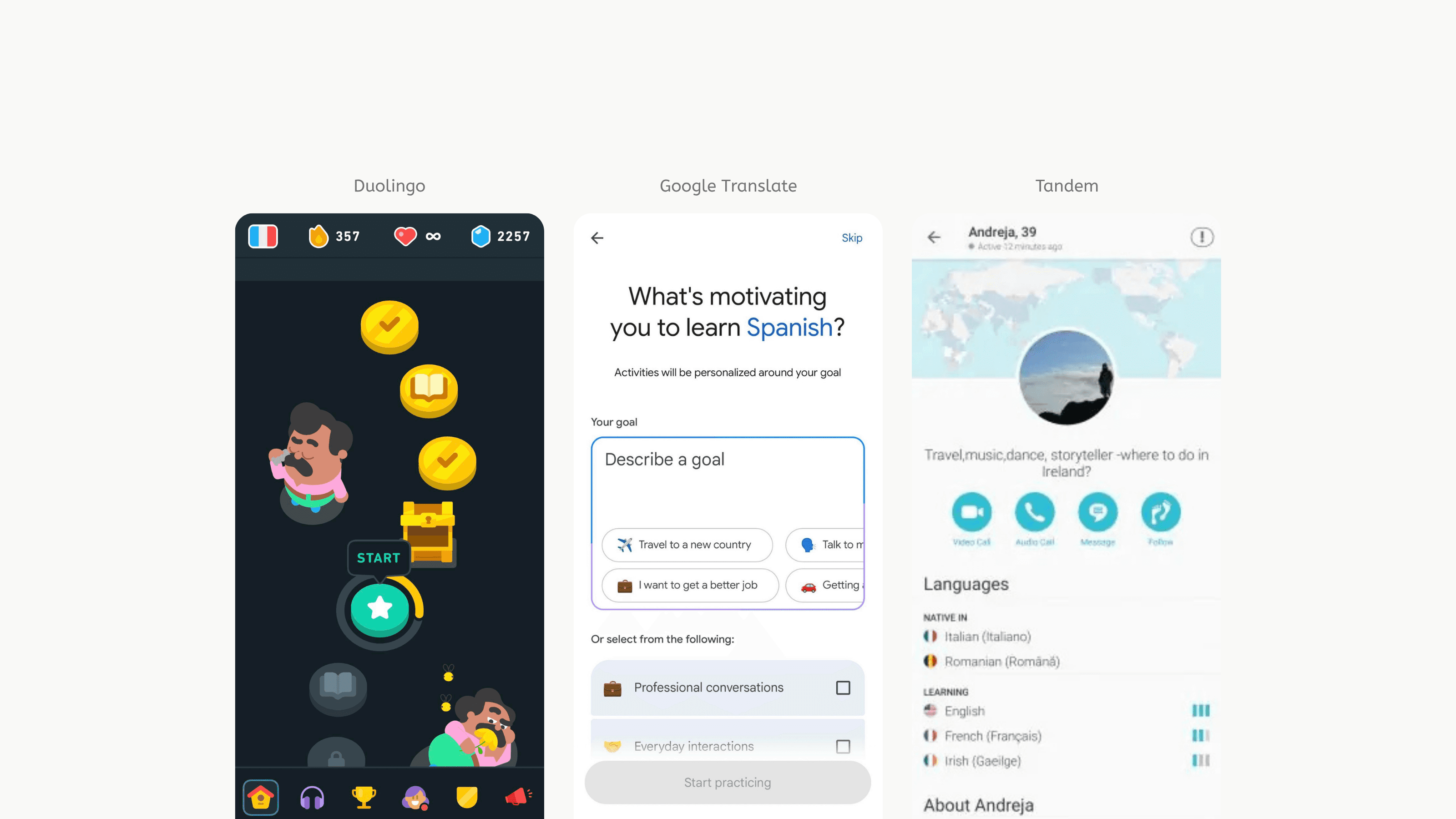
We audited language learning and social apps including Duolingo, Babbel, Google Translate's Practice Mode, and Tandem. We identified a core gap between all of these language-learning platforms. Structured tools build passive knowledge, but don't provide a natural leap to real human conversation. On the other hand, social tools like Tandem and Discord assume users are already confident enough to initiate, which is not always accurate.
competitive analysis
We audited language learning and social apps including Duolingo, Babbel, Google Translate's Practice Mode, and Tandem. We identified a core gap between all of these language-learning platforms. Structured tools build passive knowledge, but don't provide a natural leap to real human conversation. On the other hand, social tools like Tandem and Discord assume users are already confident enough to initiate, which is not always accurate.
competitive analysis
We audited Duolingo, Babbel, Google Translate's Practice Mode, Tandem, and the Language Cafe Discord server. The core gap across all of them was the same: structured tools build passive knowledge but don't scaffold the leap to real human conversation, while social tools like Tandem and Discord assume users are already confident enough to initiate — exactly what our users couldn't do.
competitive analysis
We audited Duolingo, Babbel, Google Translate's Practice Mode, Tandem, and the Language Cafe Discord server. The core gap across all of them was the same: structured tools build passive knowledge but don't scaffold the leap to real human conversation, while social tools like Tandem and Discord assume users are already confident enough to initiate — exactly what our users couldn't do.
03. ideating the product
03. ideating the product
03. ideating the product
crazy 8s
We held a Crazy 8s session that generated ideas ranging from slang reels to gamified phone calls to a desktop pet extension. From there, we narrowed our ideas down to two primary directions: a short-form video feed integrated into Duolingo, and an asynchronous voice memo feature. However, after further exploring the problem space and conducting research, we pivoted to Bumble after realizing the social matching layer fit more naturally inside an app already built around human connection.
crazy 8s
We held a Crazy 8s session that generated ideas ranging from slang reels to gamified phone calls to a desktop pet extension. From there, we narrowed our ideas down to two primary directions: a short-form video feed integrated into Duolingo, and an asynchronous voice memo feature. However, after further exploring the problem space and conducting research, we pivoted to Bumble after realizing the social matching layer fit more naturally inside an app already built around human connection.
CRAZY 8s
We held a Crazy 8s session that generated ideas ranging from slang reels to gamified phone calls to a desktop pet extension. We narrowed to two primary directions — a short-form video feed integrated into Duolingo, and an asynchronous voice memo feature — before pivoting to Bumble after realizing the social matching layer fit more naturally inside an app already built around human connection.
crazy 8s
We held a Crazy 8s session that generated ideas ranging from slang reels to gamified phone calls to a desktop pet extension. We narrowed to two primary directions — a short-form video feed integrated into Duolingo, and an asynchronous voice memo feature — before pivoting to Bumble after realizing the social matching layer fit more naturally inside an app already built around human connection.
style guide
We aligned with Bumble's existing design system, which included bold typography, the signature yellow and black color palette, and rounded card components. This ensured our extension felt native to the app rather than a later addition.
style guide
We aligned with Bumble's existing design system, which included bold typography, the signature yellow and black color palette, and rounded card components. This ensured our extension felt native to the app rather than a later addition.
style guide
We aligned with Bumble's existing design system — bold typography, the signature yellow and black color palette, and rounded card components — to ensure our extension felt native to the app rather than bolted on. The Fluency Mode badge and AI interaction panels used the same visual language while introducing subtle differentiators to signal the feature's distinct purpose.
style guide
We aligned with Bumble's existing design system — bold typography, the signature yellow and black color palette, and rounded card components — to ensure our extension felt native to the app rather than bolted on. The Fluency Mode badge and AI interaction panels used the same visual language while introducing subtle differentiators to signal the feature's distinct purpose.

rapid wireframing
We sketched three flows: a lesson-integrated colloquial term flow, a standalone media reels tab, and a profile/vocab card system. Sketching directly against our user flows helped us stress-test screen-by-screen logic early and borrow familiar UI conventions from Instagram Reels and TikTok while adapting them for a language learning context.
rapid wireframing
We sketched three flows: a lesson-integrated colloquial term flow, a standalone media reels tab, and a profile/vocab card system. Sketching directly against our user flows helped us stress-test screen-by-screen logic early and borrow familiar UI conventions from Instagram Reels and TikTok while adapting them for a language learning context.
rapid wireframing
We sketched three flows: a lesson-integrated colloquial term flow, a standalone media reels tab, and a profile/vocab card system. Sketching directly against our user flows helped us stress-test screen-by-screen logic early and borrow familiar UI conventions from Instagram Reels and TikTok while adapting them for a language learning context.
rapid wireframing
We sketched three flows: a lesson-integrated colloquial term flow, a standalone media reels tab, and a profile/vocab card system. Sketching directly against our user flows helped us stress-test screen-by-screen logic early and borrow familiar UI conventions from Instagram Reels and TikTok while adapting them for a language learning context.
03. designing the prototype
04. building the deliverable
03. designing the prototype
USER TESTING
Two participants tested our prototype and found the flows generally intuitive, with the transcript and key phrases features in the chat receiving specific praise as genuinely useful. Both preferred Bumble Fluency over our earlier Duolingo concept for its potential to facilitate real in-person meetups. Key pain points included confusion about whether Fluency Mode was separate from the dating experience, the swiping flow feeling romantically coded, unclear AI behavior in chat, and a desire to see proficiency levels on profiles before matching.
USER TESTING
Two participants tested our prototype and found the flows generally intuitive, with the transcript and key phrases features in the chat receiving specific praise as genuinely useful. Both preferred Bumble Fluency over our earlier Duolingo concept for its potential to facilitate real in-person meetups. Key pain points included confusion about whether Fluency Mode was separate from the dating experience, the swiping flow feeling romantically coded, unclear AI behavior in chat, and a desire to see proficiency levels on profiles before matching.
user testing
Two participants tested our prototype and found the flows generally intuitive, with the transcript and key phrases features in the chat receiving specific praise as genuinely useful. Both preferred Bumble Fluency over our earlier Duolingo concept for its potential to facilitate real in-person meetups. Key pain points included confusion about whether Fluency Mode was separate from the dating experience, the swiping flow feeling romantically coded, unclear AI behavior in chat, and a desire to see proficiency levels on profiles before matching.
USER TESTING
Two participants tested our prototype and found the flows generally intuitive, with the transcript and key phrases features in the chat receiving specific praise as genuinely useful. Both preferred Bumble Fluency over our earlier Duolingo concept for its potential to facilitate real in-person meetups. Key pain points included confusion about whether Fluency Mode was separate from the dating experience, the swiping flow feeling romantically coded, unclear AI behavior in chat, and a desire to see proficiency levels on profiles before matching.
BEFORE & AFTER STORIES
Based on user feedback that the swiping screen felt too much like a dating app, we made three targeted changes: updating the header logo from "Bumble" to "Bumble Fluency" to visually anchor users in a distinct mode, elevating the language tags higher in the visual hierarchy so a profile's purpose is immediately clear, and reframing the interests section with the label "Let's Have a Conversation About…" — a small copy shift that re-contextualizes shared hobbies as conversation starters rather than compatibility signals.
BEFORE & AFTER STORIES
Based on user feedback that the swiping screen felt too much like a dating app, we made three targeted changes: updating the header logo from "Bumble" to "Bumble Fluency" to visually anchor users in a distinct mode, elevating the language tags higher in the visual hierarchy so a profile's purpose is immediately clear, and reframing the interests section with the label "Let's Have a Conversation About…" — a small copy shift that re-contextualizes shared hobbies as conversation starters rather than compatibility signals.
before & after stories
Based on user feedback that the swiping screen felt too much like a dating app, we made three targeted changes: updating the header logo from "Bumble" to "Bumble Fluency" to visually anchor users in a distinct mode, elevating the language tags higher in the visual hierarchy so a profile's purpose is immediately clear, and reframing the interests section with the label "Let's Have a Conversation About…" — a small copy shift that re-contextualizes shared hobbies as conversation starters rather than compatibility signals.
BEFORE & After STORIES
Based on user feedback that the swiping screen felt too much like a dating app, we made three targeted changes: updating the header logo from "Bumble" to "Bumble Fluency" to visually anchor users in a distinct mode, elevating the language tags higher in the visual hierarchy so a profile's purpose is immediately clear, and reframing the interests section with the label "Let's Have a Conversation About…" — a small copy shift that re-contextualizes shared hobbies as conversation starters rather than compatibility signals.
final prototype
The final hi-fi prototype covers three flows in Bumble: an onboarding sequence where users declare their native language, target language, and learning goals; a voice memo chat where an AI helper surfaces key phrases and transcripts from each exchange; and a swiping and matching flow with language-focused profile badges replacing romantic compatibility cues.
final prototype
The final hi-fi prototype covers three flows in Bumble: an onboarding sequence where users declare their native language, target language, and learning goals; a voice memo chat where an AI helper surfaces key phrases and transcripts from each exchange; and a swiping and matching flow with language-focused profile badges replacing romantic compatibility cues.
final prototype
The final hi-fi prototype covers three flows in Bumble: an onboarding sequence where users declare their native language, target language, and learning goals; a voice memo chat where an AI helper surfaces key phrases and transcripts from each exchange; and a swiping and matching flow with language-focused profile badges replacing romantic compatibility cues.
final prototype
The final hi-fi prototype covers three flows in Bumble: an onboarding sequence where users declare their native language, target language, and learning goals; a voice memo chat where an AI helper surfaces key phrases and transcripts from each exchange; and a swiping and matching flow with language-focused profile badges replacing romantic compatibility cues.

04. final thoughts
05. final thoughts
04. final thoughts
key outcomes
User testing with two participants confirmed strong intuitive usability across the onboarding and chat flows, with the transcript and key phrase features receiving specific praise as genuinely useful. The primary friction point was the swiping flow feeling too romantically coded, in particular the "You Matched!" screen. This suggested that the Fluency Mode identity needs clearer visual and tonal separation from Bumble's dating context.
next steps and impact
After altering our designs to address outcomes of user testing, the next steps would be to continue the rigorous process of re-testing and further polishing the interfaces. The app is currently a working prototype, and next steps would be to implement it using code and conduct testing from there.
key outcomes
User testing with two participants confirmed strong intuitive usability across the onboarding and chat flows, with the transcript and key phrase features receiving specific praise as genuinely useful. The primary friction point was the swiping flow feeling too romantically coded, in particular the "You Matched!" screen. This suggested that the Fluency Mode identity needs clearer visual and tonal separation from Bumble's dating context.
next steps and impact
After altering our designs to address outcomes of user testing, the next steps would be to continue the rigorous process of re-testing and further polishing the interfaces. The app is currently a working prototype, and next steps would be to implement it using code and conduct testing from there.
key outcomes
User testing with two participants confirmed strong intuitive usability across the onboarding and chat flows, with the transcript and key phrase features receiving specific praise as genuinely useful rather than gimmicky. The primary friction point was the swiping flow feeling too romantically coded — particularly the "You Matched!" screen — suggesting the Fluency Mode identity needs clearer visual and tonal separation from Bumble's dating context.
next steps and impact
After altering our designs to address outcomes of user testing, the next steps would be to continue the rigorous process of re-testing and further polishing the interfaces. The app is currently a working prototype, and next steps would be to implement it using code and conduct testing from there.
key outcomes
User testing with two participants confirmed strong intuitive usability across the onboarding and chat flows, with the transcript and key phrase features receiving specific praise as genuinely useful rather than gimmicky. The primary friction point was the swiping flow feeling too romantically coded — particularly the "You Matched!" screen — suggesting the Fluency Mode identity needs clearer visual and tonal separation from Bumble's dating context.
next steps and impact
After altering our designs to address outcomes of user testing, the next steps would be to continue the rigorous process of re-testing and further polishing the interfaces. The app is currently a working prototype, and next steps would be to implement it using code and conduct testing from there.
the team!
the team!
Alice Guo
Jamie Han
Supicha Songpetchmongkol
Alice Guo
Jamie Han
Supicha Songpetchmongkol
Alice Guo
Jamie Han
Supicha Songpetchmongkol